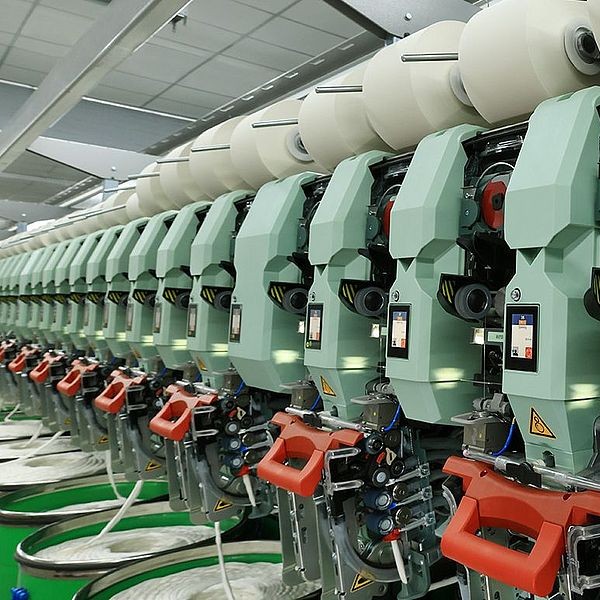
air-jet spinning machine
The fibers are twisted by air current; very fast, suitable for medium-fine yarns. Air-jet spinning (also called air spinning, jet spinning, or fasciated yarn spinning) is a method of spinning staple-fiber yarns in which a high-velocity stream of compressed air twists wrapper fibers around a core of parallel fibers. The resulting yarn has a fasciated structure (a largely parallel core wrapped in twisted fibers). Air-jet spinning development initiated in the mid-1950s and was first successfully commercialized by Murata Machinery in Japan during the early 1980s. Today, it is used for high-speed production of knitted and woven yarns with low hairiness. ..."In recent years, hemp textiles have gained attention as a sustainable alternative to cotton. However, the uneven fineness and length of hemp fibers, along with their stiffness, adversely affect spinnability and exacerbate yarn evenness and hairiness, particularly due to short fibers. This study introduces a modified sustainable droplet-wet spinning technology aimed at enhancing hemp yarn quality, with a primary focus on reducing yarn hairiness. Implemented on a ring spinning machine, the technology utilizes a syringe connected to an adjustable-speed pump, delivering water onto the front top roller. This innovative approach enhances hemp yarn in two ways: firstly, the cohesive force of water promotes the consolidation of short fibers on both sides of the fiber bundle towards the center, thereby condensing the spinning triangle. Consequently, the fibers on both sides of the fiber bundle are more readily drawn into the spinning triangle and twisted to form yarn; secondly, wet hemp fibers possess a lower modulus, rendering them softer and more deformable, facilitating their embedding into the yarn, thereby enhancing yarn tenacity and reducing yarn hairiness. The study systematically investigates the relationship between droplet-wet spinning parameters (water droplet rate, hemp fiber content of the roving, and yarn twist multiplier) and hemp yarn quality. Experimental results reveals that optimal droplet-wet spinning lead to a 22% increase in yarn tenacity and about 50% reduction in hairiness. A higher hemp fiber content in the roving contributes to better performance of droplet-wet spinning technology in enhancing yarn quality. Moreover, droplet-wet spinning enables the production of high-quality hemp yarn at lower twist multipliers, thereby reducing electricity consumption during yarn production. Subsequently, the performance of knitted fabrics made from conventional ring-spun yarn and droplet-wet spun yarn was compared and analyzed. The results indicate that fabric made from droplet-wet spun yarn exhibits an approximately 8% increase in bursting strength and a one-level improvement in pilling resistance. This research highlights the potential of droplet-wet spinning technology to enhance hemp yarn quality and promote sustainable textile production.
Show more