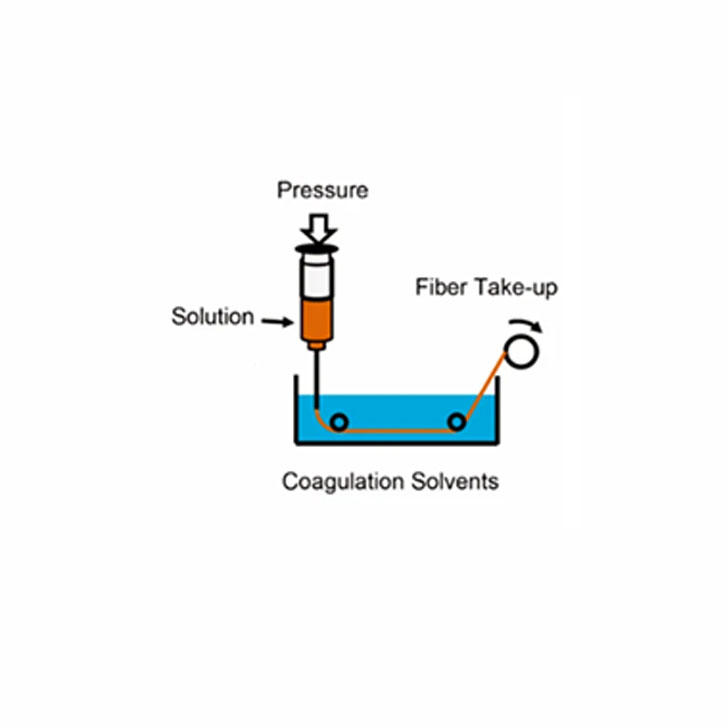
wet spinning
Wet-spinning, originally introduced for the production of viscose fiber (rayon), involves dissolving polymers in a suitable solvent before spinning. Unlike dry-spinning, the solvent used does not have to be volatile. For exemple viscose, aramid, spandex
Process principle. During wet-spinning, the polymer solution is extruded through a spinneret into a coagulation bath, where phase inversion and precipitation of the polymer occur. This process leads to the formation of fibers from the solution, with the polymer passing from a dissolved state to a solid form due to contact with the coagulation medium. Materials suitable for wet-spinning. Both natural and synthetic polymers, such as gelatin, alginate, collagen and cellulose, are processed into fibers by this technique. Wet-spinning is particularly suitable for polymers that cannot be processed by melt or dry spinning.
Show more