industrial dyeing
Industrial dyeing is a technological process in which textile materials (fibers, yarns, fabrics or finished products) are dyed using chemical dyes or pigments to obtain the desired and durable color. This process is a key part of textile production and requires expertise in the fields of chemistry, materials engineering and technological processes.
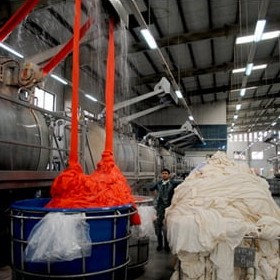
Basic methods of industrial dyeing: Periodic (discontinuous) dyeing: The material is immersed in a dye bath for a certain time, where the absorption and fixation of the dye in the fibers takes place. After the process, the material is washed to remove unfixed dye and chemical residues.
- Continuous dyeing: The material undergoes a series of technological operations (e.g. dyeing, wringing, fixing, washing) without interruption, which allows for high efficiency and uniformity of dyeing, especially in large production volumes.
- Semi-continuous dyeing: Combines elements of both previous methods – some steps are continuous, others discontinuous.
Technological dyeing steps
1. Material preparation: Includes cleaning, degreasing, or mercerization (for cotton), which improves dye uptake and increases the luster and strength of the fabric.
2. Dye selection: The type of dye is selected according to the type of fiber (e.g. reactive dyes for cotton, disperse dyes for polyester), taking into account the desired color fastness and other properties. Currently, natural dyes of mineral or vegetable origin are gradually being implemented in European industry.
3. Dye application: The material is dyed either by dipping in a solution (discontinuous) or by soaking and wringing (continuous).
4. Dye fixation: It is carried out under heat or with the help of chemical or natural agents by injection or in a water dye bath, so that the dye is firmly bound to the fiber and the desired color fastness is achieved.
5. Washing and finishing: After dyeing, the material is thoroughly rinsed to remove residues of unfixed dye and chemicals, thus ensuring the quality and health safety of the product.
Special and modern methods :
- Solution dyeing/dope dyeing: The dye is added to the polymer solution before the synthetic fiber is formed, which achieves high color fastness, lower water and chemical consumption, and more environmentally friendly production.
- Digital and ecological methods: Modern technologies, such as digital printing or green dyeing, reduce water and energy consumption and enable precise and individualized dyeing of textiles.
Show more